Your Yacht Design Deserves More Than a Rendering
Luxury yacht design is visual by nature.
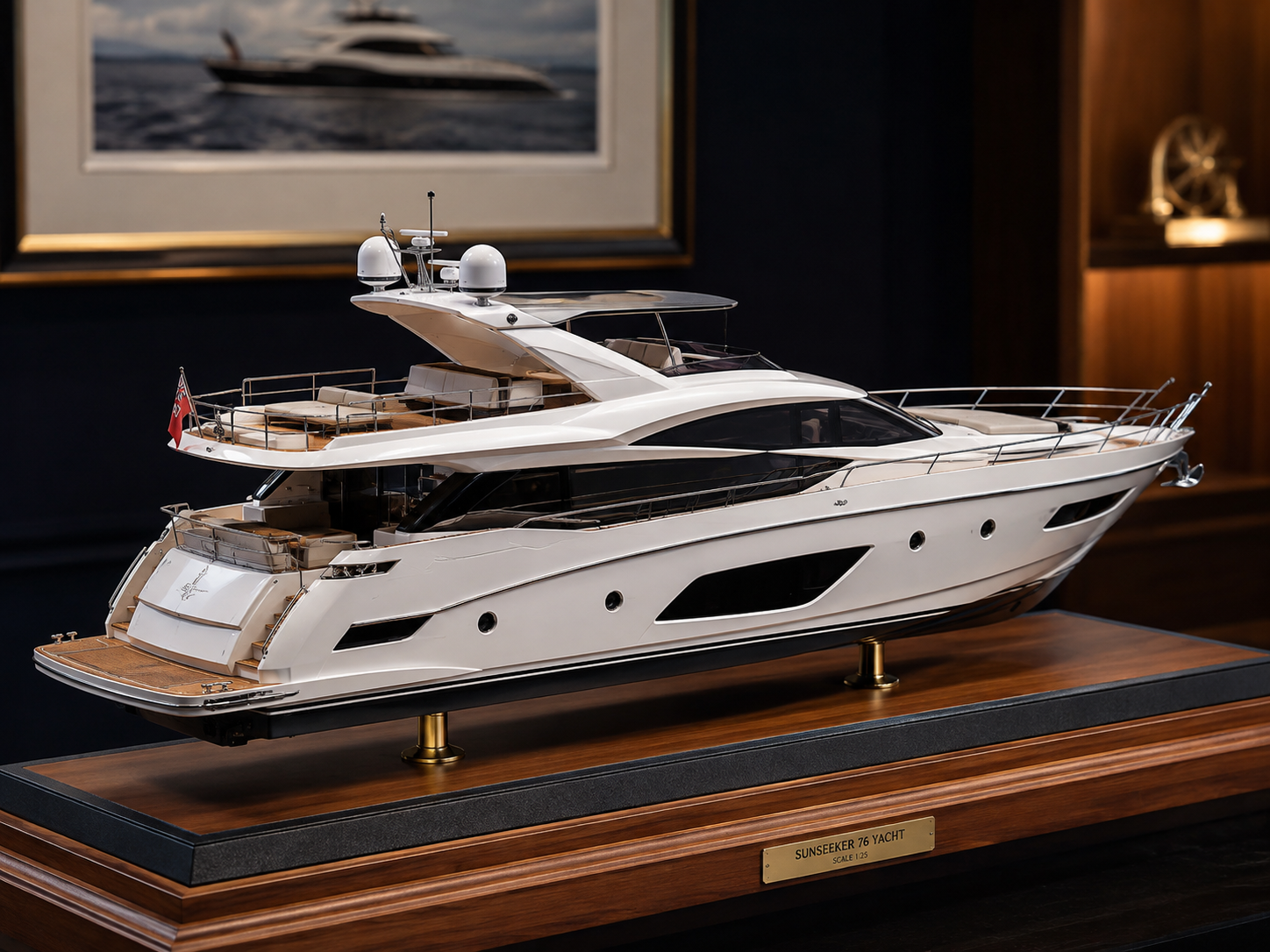
A yacht may be recognized by the curve of its bow, the continuous line of its glazing, the structure of its upper decks or the relationship between the stern, swim platform and exterior lounge areas.
That makes the yacht industry particularly well suited to physical scale models.
Around an event such as Monaco Yacht Show, builders, designers and brokers need to communicate yacht concepts quickly, professionally and memorably.
A detailed Custom Yacht Model can turn a vessel design into something a potential owner can see from every angle. Scales Model supports custom projects developed from suitable drawings, photos and digital design references.
A Physical Model Makes the Yacht Tangible
Renderings are powerful.
Virtual reality is impressive.
But a physical yacht model adds something different: presence.
The model sits in the room with the customer.
There is no screen to operate, no camera angle selected by a designer and no need to explain where the bow ends or how the superstructure flows into the aft deck.
The client can simply walk around it.
For a yacht builder, that makes a custom scale model particularly valuable during early owner meetings.
Superyacht Models for Newbuildings
A superyacht project may begin years before the finished vessel enters the water.
During that time, the yacht may already need to be presented to owners, stakeholders, partners or the international market.
Scales Model’s Prototype Models and CAD & 3D Design services can support appropriate proposed-vessel projects before the real yacht exists.
The model can be developed around the visible form of the design — hull geometry, glazing, decks, mast structures and external features — based on the information available.
Marine Ship Models’ article on How the Singapore Yachting Festival 2026 Is Driving Demand for Custom Yacht Models in Asia similarly discusses exhibition models as tools for yacht builders to attract visitors, demonstrate vessel features and reinforce brand identity.
Yacht Models for Brokers
A broker faces a practical challenge: the yacht is rarely where the buyer is.
The vessel may be cruising in the Mediterranean while the client is meeting the broker elsewhere.
A physical model does not replace the real yacht or the sales documentation, but it gives the conversation a focal point.
The broker can use the model to discuss deck arrangements, exterior styling and the overall yacht profile.
For larger brokerage companies, several models can form a professional showroom collection.
Private Owner Yacht Replicas
The purpose changes again for a private owner.
A scale model can become a personal representation of the owner’s actual yacht.
It may be displayed at home, in an office or aboard another property. It can also preserve a specific moment in the yacht’s history — for example, the original delivery configuration or a significant refit.
This is where vessel-specific information becomes especially important.
The model should represent that yacht, not simply a similar design.
Motor Yachts, Superyachts, Sailing Yachts and Catamarans
Scales Model’s Yacht Models structure can cover several distinct model types:
motor yachts, superyachts, sailing yachts, catamarans, explorer-style yachts and concept designs.
Each requires a different visual emphasis.
Motor-yacht models may focus on glazing, flybridge structures and exterior deck spaces.
Sailing-yacht models naturally place greater emphasis on mast, boom and rigging.
Catamarans require accurate twin-hull relationships and bridge-deck geometry.
The Marine Ship Models site also publishes wider yacht-industry material through its Asia Yacht Show 2026 resource, which discusses personalization as a major characteristic of contemporary yacht demand.
Yacht Models for Exhibition Stands
A yacht show is one of the clearest use cases for an Exhibition Model.
Many yacht builders cannot bring every vessel in their portfolio to a show.
Some vessels are under construction. Others are operating. Some are still concepts.
Models allow the builder to present several designs inside one stand.
A visitor can compare them physically.
The design team can point out differences.
The sales team can move from one model to another as the conversation develops.
Branding and Presentation
A premium yacht model should look like it belongs in a luxury-sales environment.
That means the model itself is only part of the project.
The display base, project plaque, protective case and overall finish all contribute to the final presentation.
A yacht name and builder identity can also become important when supplied as part of the project references.
This is why the same model can later transition naturally from a show stand into a Corporate Display or builder showroom.
Yacht Projects and Portfolio Content
Scales Model also maintains a separate Yacht Projects section.
That distinction matters.
The Yacht Models page should answer: “What can you make?”
The Yacht Projects page can increasingly answer: “What types of yacht projects have been presented?”
Together they create a stronger search and customer journey.
Preparing for an International Yacht Show
A yacht-model project should ideally begin with the material already available:
GA drawings, principal dimensions, photographs, CAD or 3D files, renderings, colors, desired model scale and display requirements.
Scales Model can then review these references, plan the model and move the project through production, inspection, Packaging and Worldwide Shipping.
Bring the Yacht Into the Meeting Room
A yacht can be hundreds or thousands of miles away.
Its physical representation does not have to be.
For builders, brokers, designers and owners preparing for Monaco Yacht Show or another yacht-industry presentation, a custom scale model can bring the vessel directly into the conversation.
 English
  Chinese
  Spanish
  German
  French
  Indonesian
  Korean
  Japanese